
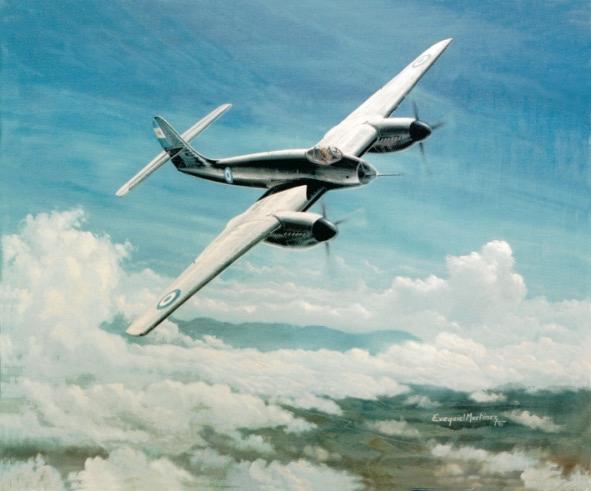

The IAe-30 Ñamcú was born out of the necessity for an escort fighter to accompany the massive Lancaster and Lincoln heavy bombers that Argentina was receiving at the time. Lessons learned from World War II highlighted the need for a heavy, high-speed fighter with long-range capabilities and heavy armament.
The design team, led by Cesare Pallavicino, was influenced by the recently arrived German engineer Kurt Tank, leading to the aircraft’s distinctive triangular fuselage cross-section. The Ñamcú took its maiden flight in 1948. During a transfer flight to Buenos Aires—operating at an economical 60% power—it reached 650 km/h (approx. 404 mph), setting a speed record for piston-engine aircraft that remains a legendary milestone in Argentine aviation history. It proved to be an exceptional machine, even outperforming the jet-powered Pulqui I in terms of speed.
Rolls-Royce pushed to showcase the aircraft in Europe to market the design to other nations. Plans were made for a transatlantic crossing accompanied by an Avro Lancastrian; however, the project was abruptly canceled, along with an initial order for 200 units. The exact reasons for the cancellation were never fully clarified, though it is widely believed that political pressure from the United States on Great Britain played a role, as the U.S. viewed the Peronist administration of the time with distrust.
While similar to the British De Havilland Hornet, the Ñamcú featured superior aerodynamic “cleanness” due to its landing gear, which retracted horizontally into the engine nacelles. Had this aircraft entered mass production, it arguably would have been the finest aircraft of its class in the world.
The IAe-30 flew in 1948, but budget constraints ultimately halted the production of 210 units. Its planned armament consisted of six 20mm cannons, cementing its status as potentially one of the fastest piston-engine aircraft ever built.
Artwork by Exequiel Martínez
The IAe-30 Ñamcú was an advanced training aircraft designed and built by the Fábrica Militar de Aviones in Córdoba, first flying in 1948. Its Mapuche name means eagle or condor. This work by Exequiel Martínez documents one of the most elegant designs produced by the Argentine aeronautical industry, one that in its era competed with the world’s best. Learn more in the artist’s biography.