
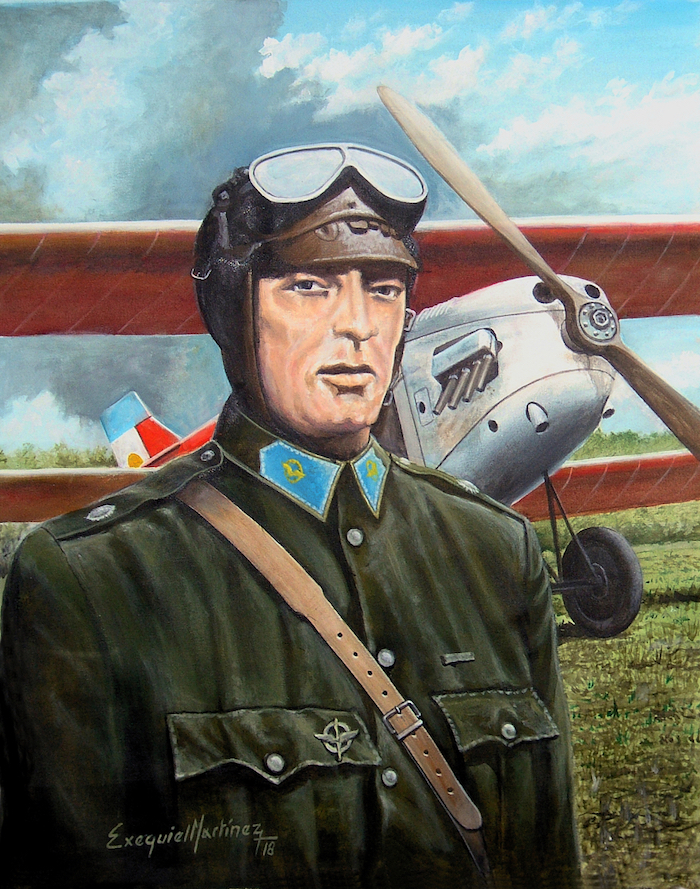

Pedro was born on March 12, 1891. He entered the Military College in 1906 and graduated as an Artillery officer in 1909.
In 1912, he became a military aviator in the first graduating class of what was then the Military Aviation School. He earned Argentine Pilot License No. 23.
He was a key figure in the double crossing of the Andes Mountain Range in 1920 alongside Captain Antonio Parodi.
In 1924, Pedro Zanni began his extraordinary attempt to circumnavigate the globe, a journey that led him to cover 19,320 kilometers between Amsterdam and Tokyo in 25 days of flight. He was accompanied by his inseparable mechanic, Mr. Felipe Beltrame, a distinguished Chief of Mechanics at El Palomar Air Base, and Ensign Nelson Page, a Naval Aviator selected by Zanni as co-pilot and navigator.
At that time, many parts of the planet were still unexplored, and with the development of the airplane, different countries carried out pioneering long-distance flights that would later become the foundations of commercial air routes. These routes would enable humanity to quickly cover vast regions long before they were fully connected by land or sea.
Thus began the race between the ocean liner and the airplane. The immensity of these regions required titanic efforts due to the fragile and primitive aircraft of the era. Four countries were competing at that time for the honor of being the first to fly around the world: the United States, Portugal, the United Kingdom, and the Argentine Republic.
Circumnavigating the globe in that era was an imposing undertaking—especially from the position of an Argentine pilot, and even more so since the venture was not an official government mission but a private one. Many of the regions were colonial territories where Argentina had neither consulates nor formal representation. Flight permissions and entry authorizations required lengthy bureaucratic procedures.
The expedition cost £17,800 (including aircraft, spare parts, fuel, and all necessary equipment)—a fortune at the time—funded entirely by public donations and contributions from the Argentine people. Sponsored by the Aero Club Argentino, the raid received no government financial support. While everything was ready by mid-June 1924, an injury to Ensign Page delayed the departure. His health worsened, requiring two surgeries for osteomyelitis. By late June, he had to be moved to France for further treatment, and his long recovery forced Zanni to leave him behind to convalesce.
The journey, which began on July 26, 1924, in Amsterdam, was filled with countless hardships. They reached Haiphong on August 18, completing the first major stage. However, during a takeoff attempt there, the aircraft stalled and flipped in a rice paddy, rendering it unusable. To continue, they were sent the seaplane Provincia de Buenos Aires, equipped with floats, in which they completed the leg to Kagoshima (Tokyo), Japan, arriving on October 11.
Evaristo Velo, a Naval seaplane pilot designated as Page’s replacement, joined Zanni in Japan. Due to the monsoon season, they were forced to postpone the mission until May 1925. During that time, they conducted 25 hours of training and planned the next segments of the flight.
Favorable conditions arrived in May. In Osaka Bay, as the seaplane was reaching takeoff speed, a wave struck one of the floats and the aircraft flipped over, eliminating any possibility of continuing. Over those seven months, they had completed more than 25 hours of flight training, verified and adjusted support plans for subsequent routes, and waited for suitable conditions.
May 14 was chosen as the new departure date. After completing all necessary preparations, the takeoff run began in Osaka Bay. Just as the Provincia de Buenos Aires was reaching takeoff speed, a small swell struck one of the floats, causing the aircraft to overturn. In this unforeseen way, all possibility of fulfilling their dream was canceled. Realizing they had reached the limit of their capabilities to continue, Zanni decided to return to Argentina.
Beltrame was later assigned to France to study Engineering. He returned to Argentina in 1932, married, and settled in Córdoba, where he served as Chief Engineer of Workshops at the Military Aircraft Factory. He passed away at the age of 73 in May 1971.
Zanni continued his successful career, married, and had one son. He was posted abroad several times. While serving as Chief of El Palomar Air Base, “El Gato” Zanni—as his friends called him—was involved in a fatal accident in January 1942 when, during a nighttime return, his car collided with a poorly parked truck.
In a world filled with extraordinary communication technologies, it is difficult to grasp the immense effort made by Zanni in an era of telegraphs, engines with spark plugs and magnetos, and aircraft made of metal tubing and fabric, flying across unexplored regions inhabited by native peoples armed with bows and arrows and dressed in animal skins.
Zanni remains one of the finest examples of an aviator whose tenacity—despite limited means and scarce support—allowed him to travel halfway around the planet, competing with only a few of the most powerful teams in the world who dared attempt the same feat.