
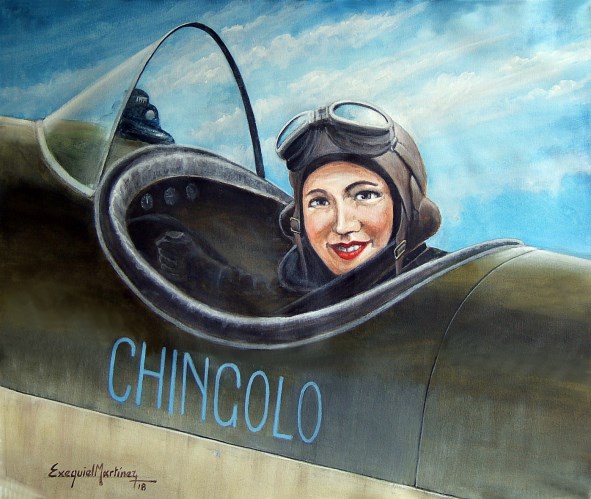

Beauty, grace, and courage are the qualities that define Myriam Stefford.
Margarita Rossi Hoffman, her real name, was born in Switzerland. She left Europe and the film sets behind to marry the Argentine Raúl Barón Biza and settle in Argentina—a country she deeply loved.
Her husband took her flying in his airplane, awakening her passion for aviation. Barón gave everything he could to his wife. He also encouraged her to venture into aviation, something completely extravagant for women at that time. She was described as “a brave, fearless woman, capable of anything.” Flying was simply another challenge for her young spirit. “I want to begin a long-distance flight and reach, with my airplane, places no other woman has ever reached,” Myriam would say. Her greatest dream was to become the first female aviator to connect Argentina with the United States.
In a short time, Myriam earned her civil pilot’s license and chose as her flight instructor Luis Fuchs, a German veteran of World War I. Her husband gave her a small two-seat, low-wing monoplane, a BFW powered by an 80-horsepower engine, built of pine wood. Stefford named her husband’s gift “Chingolo I.”
In Castelar, journalists witnessed one of her flights and reported, “—We were astonished by her daring turns, her leaf-falls, her spins, and her loopings—.” After landing, answering reporters’ questions, she said:
“I have abandoned my theatrical and film activities to devote myself to aviation. Neither ice skating, nor horseback riding, nor swimming, nor motor racing has captivated me as much as aviation.”
A journalist replied, “—You fly with enviable mastery!—”
Her response was, “—I fly intensely. Every day. For me it is a true obligation because it is one of my greatest pleasures.—”
The first challenge Myriam set for herself was to connect the capitals of fourteen Argentine provinces. On August 18, 1931, together with her instructor, she began the circuit departing from the Morón airfield. The first leg ended in Corrientes, and the following day they flew to Santiago del Estero. The third stage took them to Jujuy, where they encountered their first difficulties. Upon landing, they crashed into a fence that almost completely destroyed the airplane.
Myriam did not give up and accepted an aircraft loaned by pilot Mario Debussy. Then, always accompanied by Luis Fuchs, she continued her journey, flying to Salta, then Tucumán, and later La Rioja.
On August 26, while en route to San Juan, over the town of Marayes, the monoplane suffered a malfunction. The aircraft’s failure would cost the lives of both Myriam Stefford and her instructor.
“I want to begin a long-distance flight and reach, with my airplane, places no other woman has ever reached,” she used to say. Barón Biza had given her a two-seat monoplane built of pine wood, and in that airplane—named Chingolo—she began the raid that would ultimately lead to her death.
In Alta Gracia (Córdoba), at the entrance to her monument—shaped like a wing and rising more than 80 meters high—there was once a display case containing Myriam’s helmet, her flight watch, the rudder of the Chingolo II, and a plaque bearing the following inscription:
“Traveler, pay tribute with your silence to the woman who, in her daring, sought to soar among the eagles.”