
“If you want to know how you did in war, ask your enemy.”
— Sun Tzu, Chinese philosopher, 5th century B.C.
“I believe the Argentine pilots are demonstrating enormous bravery. It would be foolish of me not to acknowledge it.”
— John Nott, British Secretary of Defense.
“The Argentine pilots were very brave. They gave me many headaches, but I admire them nonetheless.” And regarding San Carlos (Pleasant Bay): “We had already received enough proof of what they were capable of. We saw them appear skimming the water—we would never have imagined that.”
— Admiral J. F. Woodward, Commander of the Task Force, Falklands War.
“The officer corps and many of their technicians were extremely capable, and this was particularly evident in the case of the Argentine Air Force.”
— General Jeremy Moore, Falklands War.
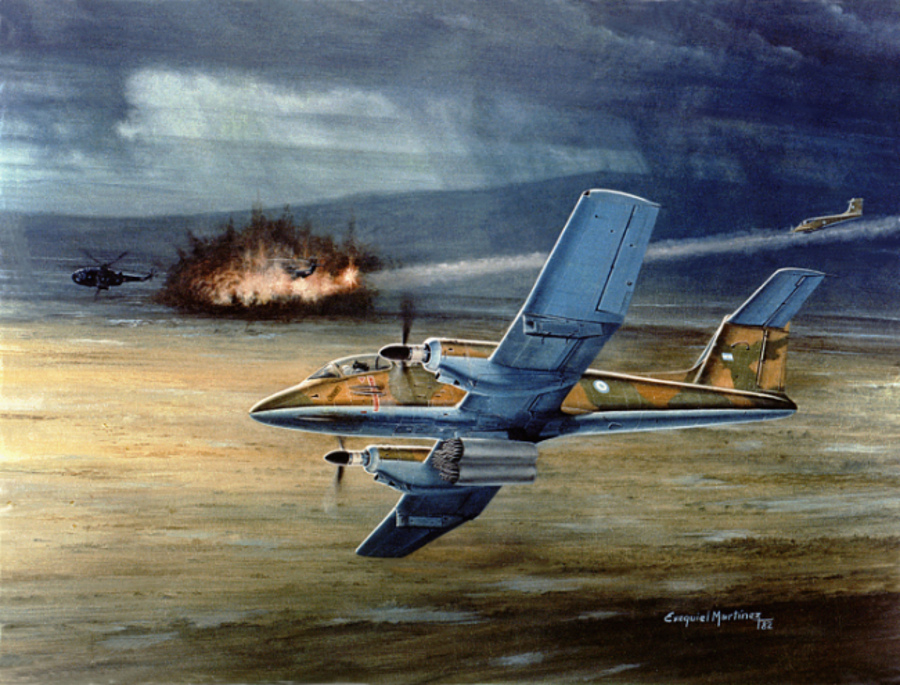
“It’s 2:00 in the afternoon on a sunny day and we are under attack by M5s and A-4Bs of the Argentine Air Force. A bomb has raised a gigantic column of water just 100 meters between our ships and a vessel loaded with supplies. We watch as the coastal batteries and missile ships open fire, along with the deafening noise of deck guns and machine guns. The crew members around us pay tribute to the courage of the Argentine pilots.”
— Gareth Parry, British newspaper The Guardian.
“The Argentine pilots win the hearts of their compatriots and the admiration of their enemies.”
— The Miami Herald.
“Buenos Aires. Almost daily they fly into battle, and each time only a few return. But the Argentine pilots have become the heroes of the Falklands War, admired by their enemies almost as much as by their fellow citizens.”
— Kenneth Freed, Los Angeles Times Service.
“They are the only ones preventing this from being a total defeat,” said a European military expert. “I don’t believe better pilots can be found anywhere in the world. To date, the British state that Argentine pilots have sunk two destroyers, two frigates, one supply ship, and several landing craft. Argentina claims that air attacks have at least put five more ships out of action and damaged five others. While Great Britain disputes part of the damage suffered, it acknowledges the skill and courage of its opponents in the air.”
— Miami Herald, 1982.
“The heroism of the Argentine pilots managed to somewhat offset the enormous imbalance of forces.”
— Air Progress Magazine, USA.
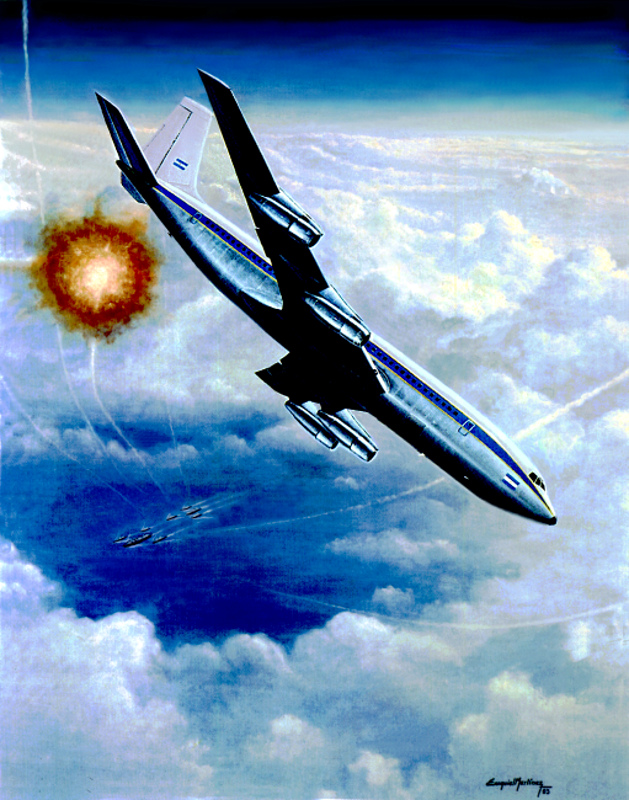
“What shocked us enormously was learning that the Argentines had flown their Hercules aircraft into Port Stanley until the very last day of the conflict.”
— Colonel J. Alford, Institute for Strategic Studies, London.
“Everything has been said about Argentine courage. Let us only add that we wish to be convinced that their patriotism finds its equivalent in certain NATO countries.”
— J. A. Gillet, France.
“The Argentine Air Force is highly regarded in public opinion—more so than before the conflict. It lost its battle, but the courage of its pilots redeemed national dignity. Its commander, Brigadier Lami Dozo, emerged as a hero, withdrawing from the discredited Junta shortly after hostilities ended.”
— B. Perret, Great Britain.
“I wish to pay my heartfelt tribute to those heroes who gave their lives for the homeland in the heroic feat of the Falklands, to those who fought for an ideal that no one can change and that we Panamanians feel as our own: The Malvinas Islands were, are, and will continue to be Argentine.”
— J. E. Illueca, President of Panama
Author’s Reflection:
Air Force No. 33 faced the world’s third-largest naval fleet. Analysts advising the House of Lords and the House of Commons had predicted that the British Fleet would sink the Argentine Fleet within 24 to 48 hours, then position itself halfway between the Islands and the mainland so that its missile ships—with short-, medium-, and long-range missiles—would prevent any aircraft from passing through. “Our boys” would then take the Islands without firing a shot once the Argentines surrendered from hunger.
What actually happened? How could NATO’s best strategists be so mistaken?
Both aircraft carriers were struck. The most advanced missile ships were sunk, and the rest had to withdraw beyond the reach of the aircraft. They hid either far away or behind hills to avoid being sunk.
Admiral Woodward wrote in his memoirs that on May 25 the Argentine Air Force left him with only four ships operational, that at that moment he was losing the war, and he acknowledged that it was a “green flag” ending between the Royal Navy and the Argentine aviators.
Specialists from other countries say that the Argentine Air Force won the air-sea battle, while the ground troops lost the land battle.
The world’s finest ships were sunk by 25-year-old aircraft that had once hung from the ceilings of museums in the country that built them.
What explains this phenomenon that astonished the world and the enemy?
The pilots—the pilots! They are the ones who tipped the balance.
How did they fail to realize that a country that produced a Juan Manuel Fangio would also produce pilots like these? If I remember correctly, no Englishman ever defeated Fangio.
According to the most respected aviation writers, no pilot in the world has successfully faced a more powerful enemy. Possibly the Argentine pilots are the best.
I would like to see the Russian MiG-29 pilots and the American F-16 pilots attacking a missile ship with an A-4B.
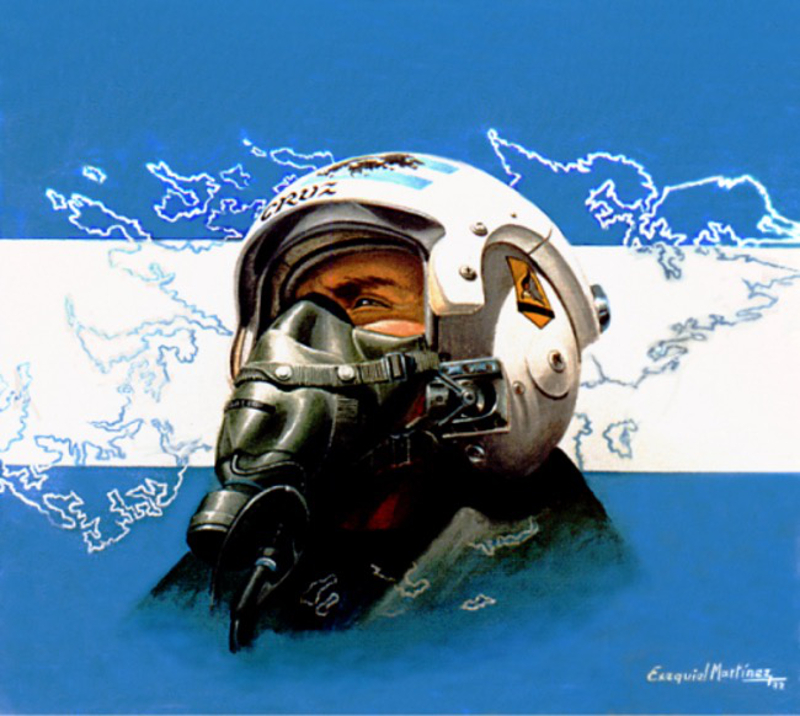
This painting is a tribute to those who astonished the world—the Argentine pilots.
To create it, I borrowed the face of Pablo Marcos Carballo, my comrade in war and in books.