
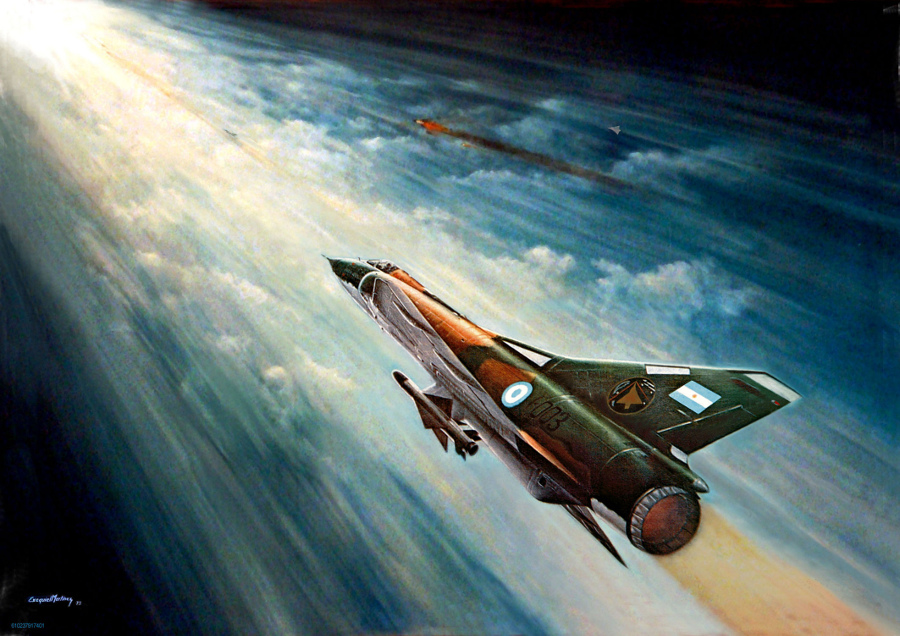

High altitude interceptors were in vogue after WWII due to the need to attack high flying bombers.
The Mirage was born following this concept and turned out to be the biggest Western Europe success becoming the core of the French defense system thanks to its simplicity, reliability and high performance. Delta wings had many advantages over straight and arrow winged planes.
High altitude interception was the criteria used in 1973 when I was commissioned this painting by the Moreno Air Base where they were stationed.
I imagined the interception of intruders high in the sky using the Matra 530 of the Mirage III.
In the painting the leader has already shot down his target; his #2 is firing his powerful missile away while #3 chases the other bogey. This work represents the theorical defense of the Argentine capital city which was the task allocated to these airplanes.
Artwork by Exequiel Martínez
This painting documents a real interception mission by the Mirage III of the Argentine Air Force, one of the most advanced fighters operated by Argentine military aviation during the Cold War. The year 1973 marks a period of peak operational activity for these French supersonic aircraft under Argentine command.
Exequiel Martínez, with his dual background as a military pilot and visual artist, captures the speed, tension and technical precision of an air interception mission. Every detail of the aircraft was verified for accuracy, ensuring the historical fidelity that characterizes his entire collection.
Learn more about the artist in his biography or explore his books on Argentine aviation in the store.
The Argentine Air Force operated the F-86 Sabre alongside the Mirage III, creating a formidable air defense capability during the 1960s and 70s. These aircraft were flown by elite pilots trained at the Escuela de Aviación Militar in Córdoba. Exequiel Martínez immortalizes these moments in aeronautical history, ensuring that the legacy of Argentina’s jet age aviators lives on through his paintings.